How to Upload a File Into R and Then Knit It
Interactive documents are a new way to build Shiny apps. An interactive certificate is an R Markdown file that contains Shiny widgets and outputs. You write the report in markdown, and and so launch information technology equally an app with the click of a push.
This commodity will show you lot how to write an R Markdown study.
The companion article, Introduction to interactive documents, volition show you how to turn an R Markdown report into an interactive certificate with Shiny components.
R Markdown
R Markdown is a file format for making dynamic documents with R. An R Markdown document is written in markdown (an piece of cake-to-write plain text format) and contains chunks of embedded R code, similar the document below.
--- output: html_document --- This is an R Markdown document. Markdown is a simple formatting syntax for authoring HTML, PDF, and MS Word documents. For more than details on using R Markdown see . When you click the **Knit** button a document will be generated that includes both content as well as the output of any embedded R code chunks within the document. You can embed an R code clamper like this: ```{r} summary(cars) ``` You lot tin also embed plots, for instance: ```{r, echo=False} plot(cars) ``` Note that the `echo = FALSE` parameter was added to the lawmaking chunk to preclude printing of the R code that generated the plot. R Markdown files are designed to be used with the rmarkdown package. rmarkdown comes installed with the RStudio IDE, only you tin acquire your ain re-create of rmarkdown from CRAN with the command
install.packages("rmarkdown") R Markdown files are the source code for rich, reproducible documents. You can transform an R Markdown file in two ways.
-
knit - You can knit the file. The
rmarkdownbundle will telephone call theknitrparcel.knitrwill run each clamper of R code in the document and suspend the results of the code to the certificate side by side to the code clamper. This workflow saves time and facilitates reproducible reports.Consider how authors typically include graphs (or tables, or numbers) in a report. The writer makes the graph, saves it as a file, and so copy and pastes it into the final written report. This process relies on manual labor. If the data changes, the writer must repeat the entire process to update the graph.
In the R Markdown image, each report contains the code it needs to make its own graphs, tables, numbers, etc. The writer can automatically update the study by re-knitting.
-
catechumen - Y'all can catechumen the file. The
rmarkdownpackage volition use thepandocprogram to transform the file into a new format. For example, y'all can convert your .Rmd file into an HTML, PDF, or Microsoft Word file. You can even turn the file into an HTML5 or PDF slideshow.rmarkdownwill preserve the text, code results, and formatting contained in your original .Rmd file.Conversion lets you practise your original work in markdown, which is very easy to use. Yous can include R code to knit, and you can share your certificate in a variety of formats.
In practice, authors almost ever knit and catechumen their documents at the aforementioned fourth dimension. In this commodity, I will utilize the term return to refer to the two step procedure of knitting and converting an R Markdown file.
You can manually render an R Markdown file with rmarkdown::return(). This is what the above document looks like when rendered as a HTML file.
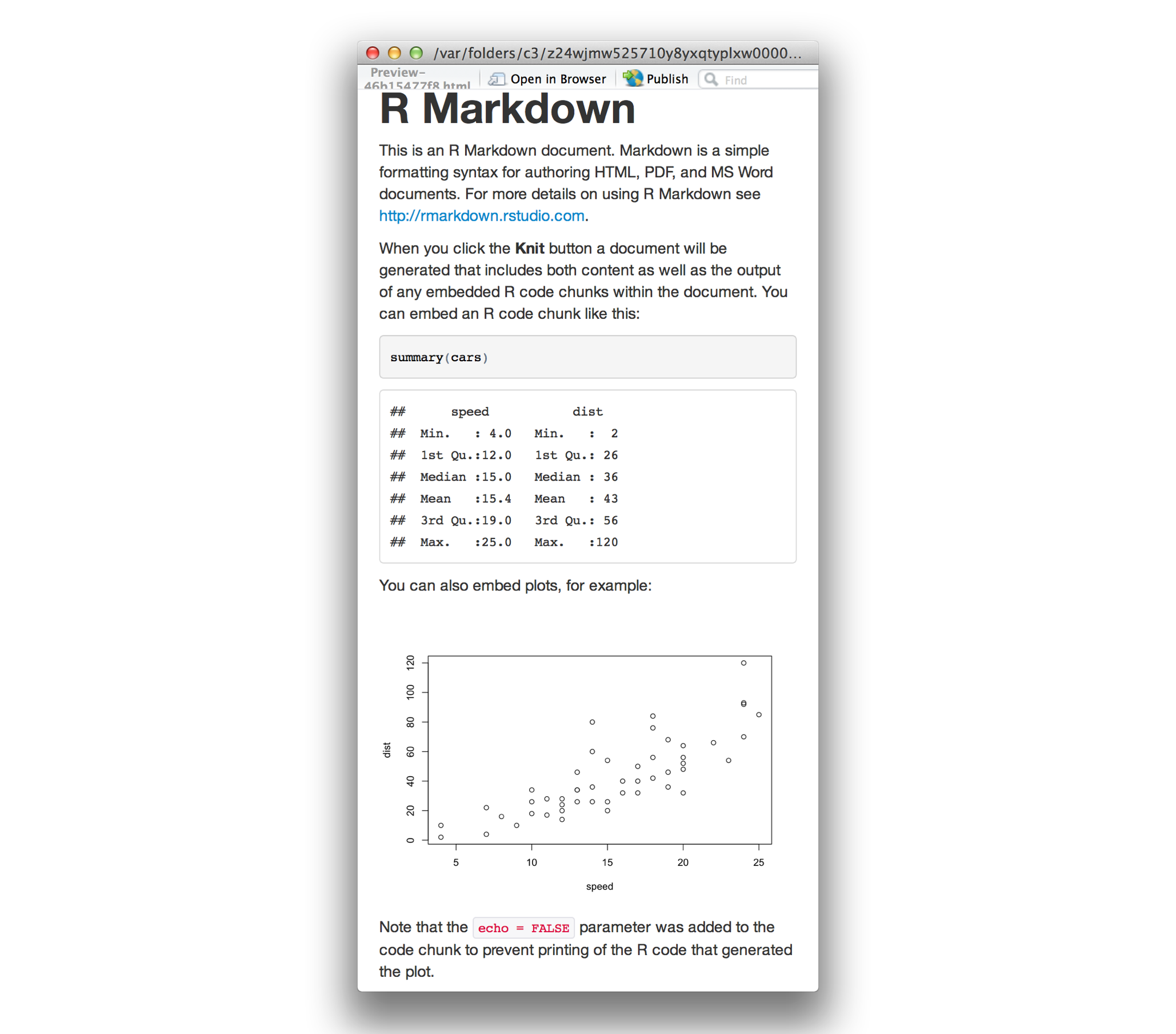
In practice, y'all practice not need to call rmarkdown::render(). You tin can use a button in the RStudio IDE to render your reprt. R Markdown is heavily integrated into the RStudio IDE.
Getting started
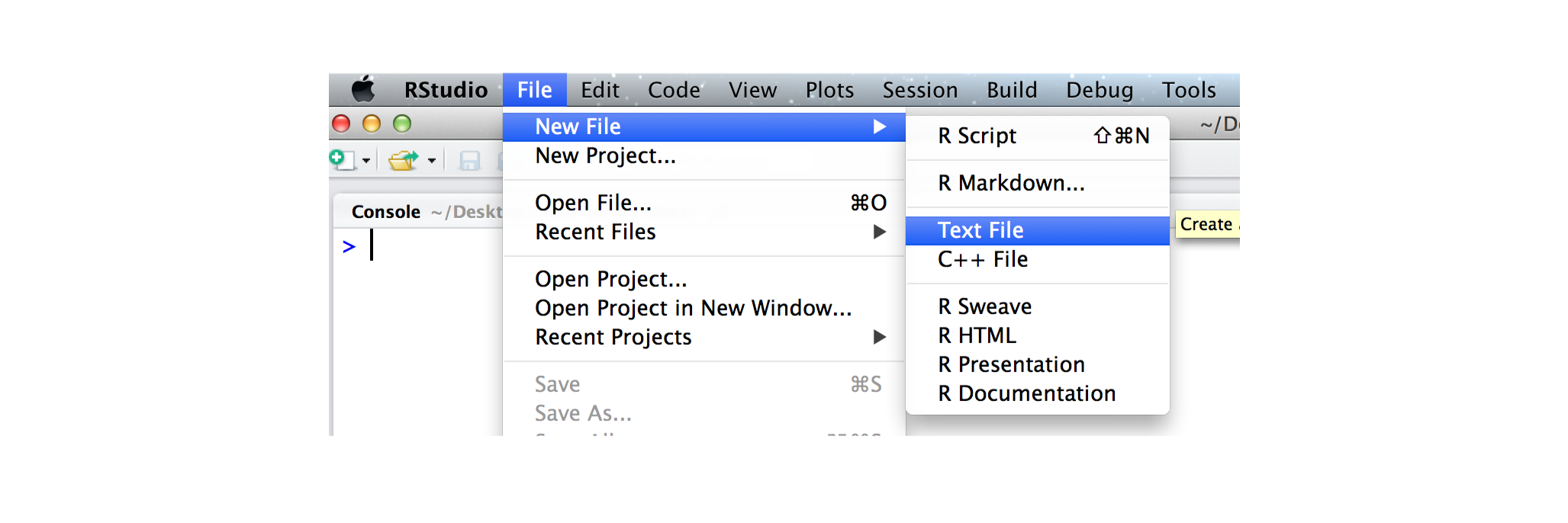
To create an R Markdown report, open up a plain text file and salvage information technology with the extension .Rmd. You can open a plain text file in your scripts editor by clicking File > New File > Text File in the RStudio toolbar.
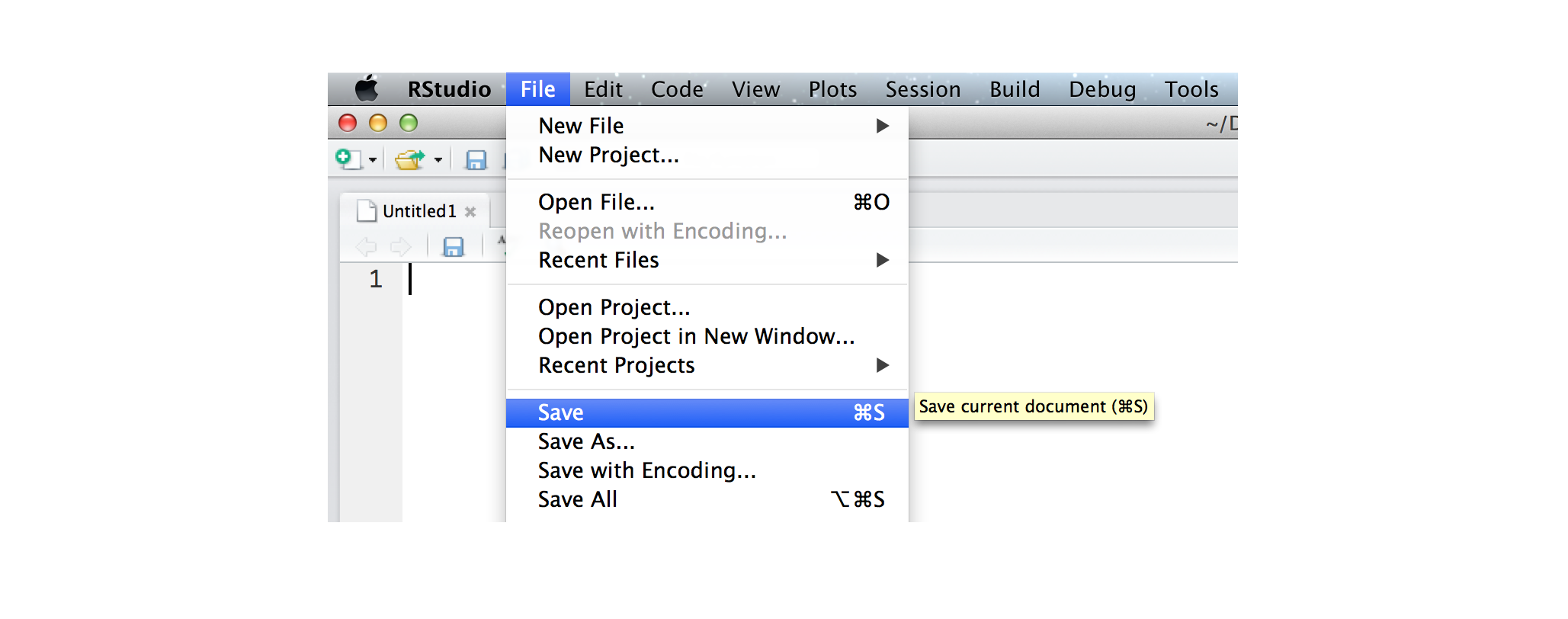
Be certain to save the file with the extension .Rmd. The RStudio IDE enables several helpful buttons when you save the file with the .Rmd extension. You lot can save your file by clicking File > Salvage in the RStudio toolbar.
R Markdown reports rely on three frameworks
- markdown for formatted text
-
knitrfor embedded R code - YAML for render parameters
The sections below depict each framework.
Markdown for formatted text
.Rmd files are meant to contain text written in markdown. Markdown is a set of conventions for formatting apparently text. You tin use markdown to point
- assuming and italic text
- lists
- headers (eastward.m., section titles)
- hyperlinks
- and much more
The conventions of markdown are very unobtrusive, which make Markdown files easy to read. The file beneath uses several of the most useful markdown conventions.
# Say Hello to markdown Markdown is an **piece of cake to use** format for writing reports. It resembles what you naturally write every time yous compose an email. In fact, you may have already used markdown *without realizing it*. These websites all rely on markdown formatting * [Github](world wide web.github.com) * [StackOverflow](www.stackoverflow.com) * [Reddit](www.reddit.com) The file demonstrates how to use markdown to indicate:
-
headers - Place one or more hashtags at the start of a line that will exist a header (or sub-header). For example,
# Say How-do-you-do to markdown. A single hashtag creates a first level header. Two hashtags,##, creates a second level header, and so on. -
italicized and bold text - Surround italicized text with asterisks, like this
*without realizing it*. Environs bold text with two asterisks, like this**easy to use**. -
lists - Group lines into bullet points that begin with asterisks. Leave a blank line earlier the starting time bullet, like this
This is a listing * item 1 * particular 2 * item 3 -
hyperlinks - Surroundings links with brackets, and and then provide the link target in parentheses, like this
[Github](www.github.com).
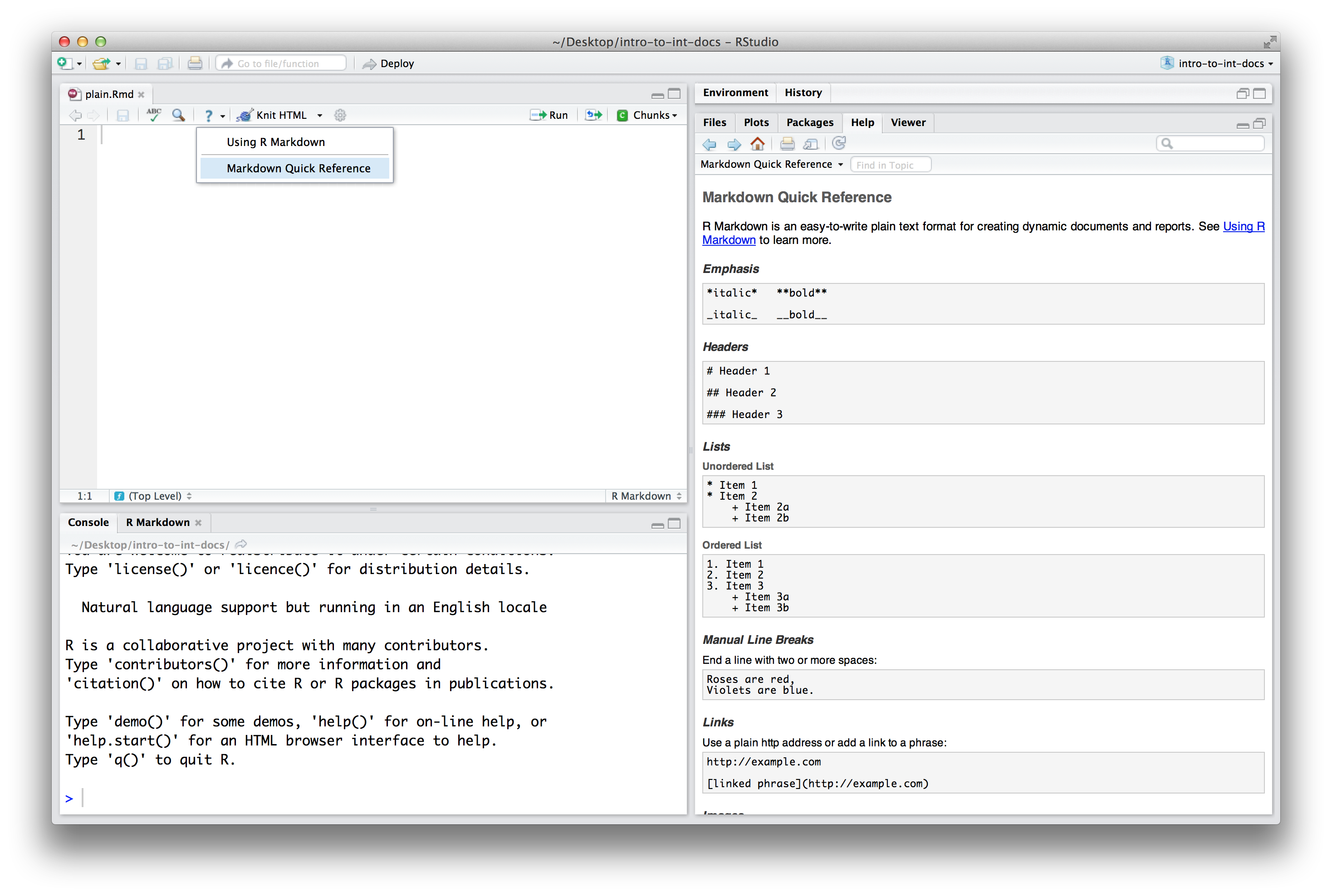
Yous can acquire about more of markdown's conventions in the Markdown Quick Reference guide, which comes with the RStudio IDE.
To access the guide, open a .md or .Rmd file in RStudio. Then click the question marker that appears at the height of the scripts pane. Next, select "Markdown Quick Reference". RStudio volition open the Markdown Quick Reference guide in the Help pane.
Rendering
To transform your markdown file into an HTML, PDF, or Word certificate, click the "Knit" icon that appears above your file in the scripts editor. A driblet downwards menu volition let you select the type of output that you want.

When you click the button, rmarkdown will duplicate your text in the new file format. rmarkdown will use the formatting instructions that you lot provided with markdown syntax.
Once the file is rendered, RStudio will show you a preview of the new output and save the output file in your working directory.
Here is how the markdown script above would look in each output format.

Note: RStudio does not build PDF and Discussion documents from scratch. You will need to have a distribution of Latex installed on your computer to brand PDFs and Microsoft Give-and-take (or a similar program) installed to make Word files.
knitr for embedded R code
The knitr package extends the bones markdown syntax to include chunks of executable R code.
When you lot return the written report, knitr volition run the code and add the results to the output file. You can have the output display merely the code, merely the results, or both.
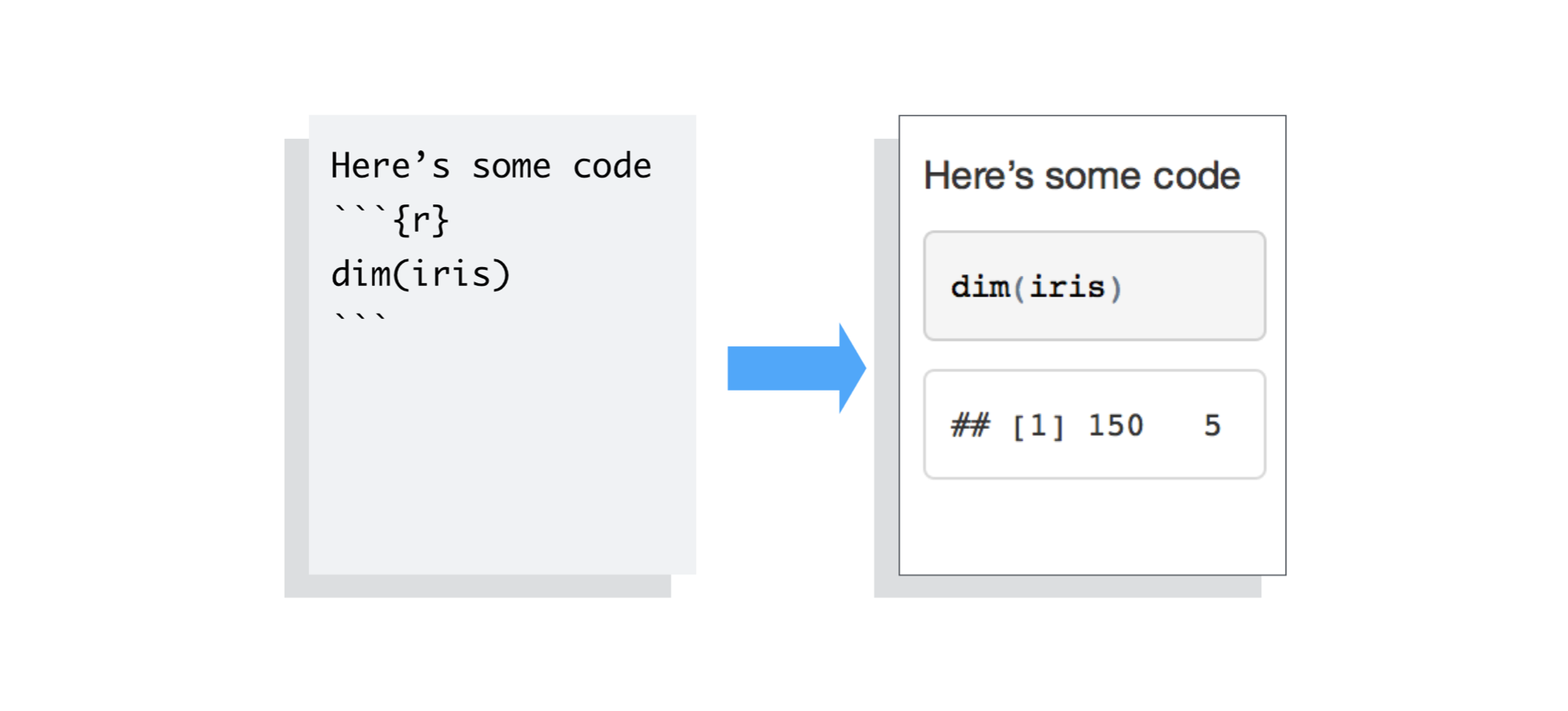
To embed a chunk of R code into your study, surround the lawmaking with two lines that each contain three backticks. Later the outset gear up of backticks, include {r}, which alerts knitr that you have included a chunk of R lawmaking. The issue will expect like this
Here's some lawmaking ```r dim(iris) ``` ``` ## [i] 150 5 ``` When you render your document, knitr volition run the code and append the results to the code clamper. knitr will provide formatting and syntax highlighting to both the lawmaking and its results (where advisable).
As a result, the markdown snippet above volition look similar this when rendered (to HTML).
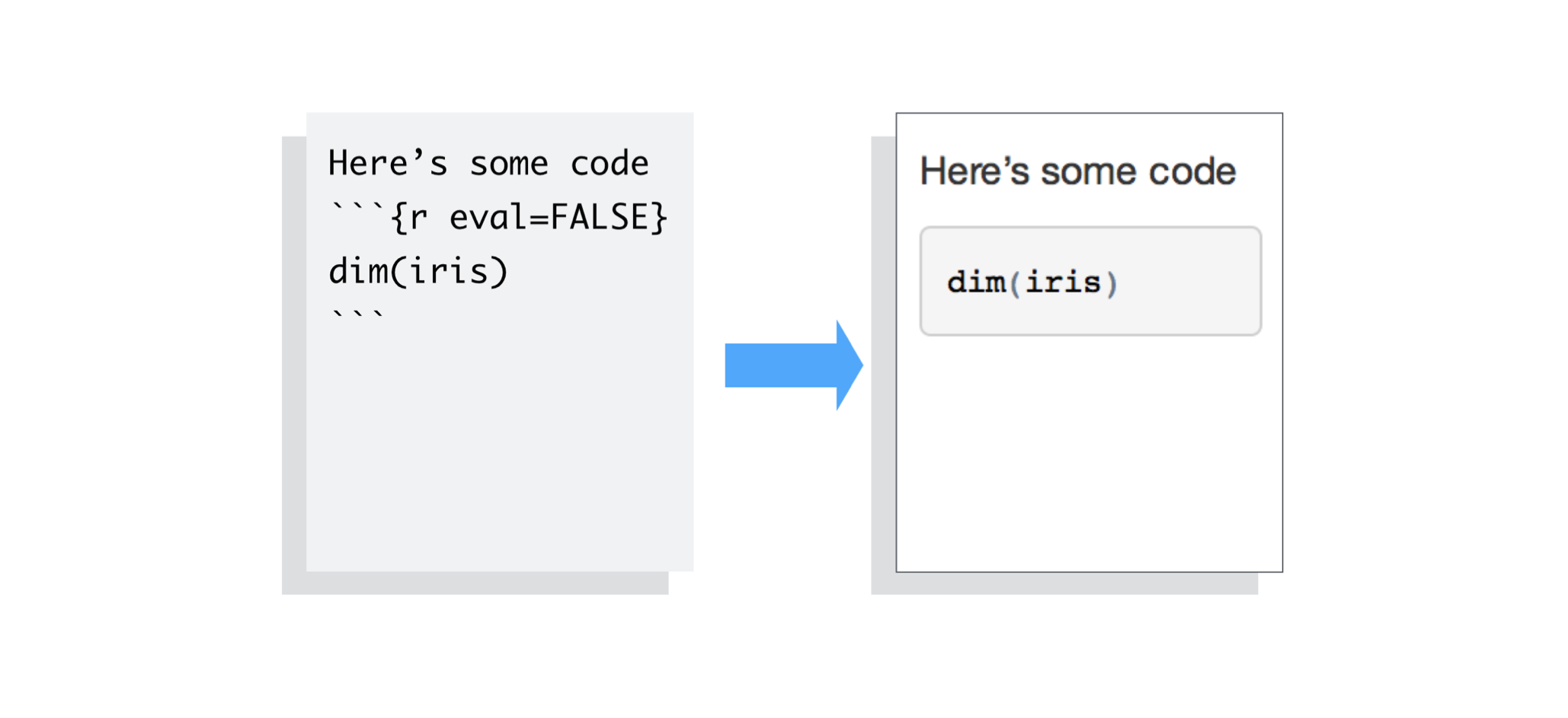
To omit the results from your final report (and not run the code) add the statement eval = FALSE inside the brackets and after r. This will place a copy of your code into the report.
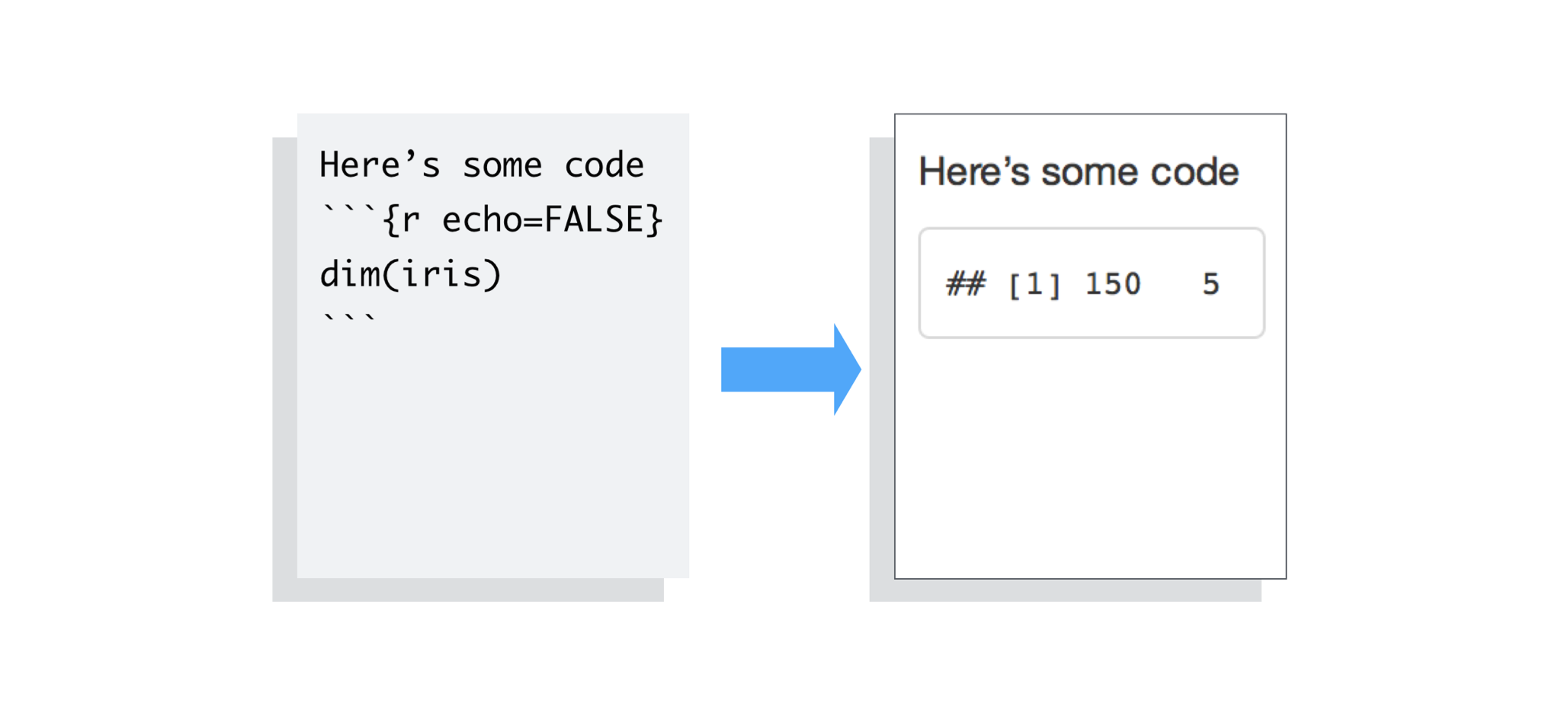
To omit the code from the final report (while including the results) add the argument echo = FALSE. This will place a copy of the results into your report.
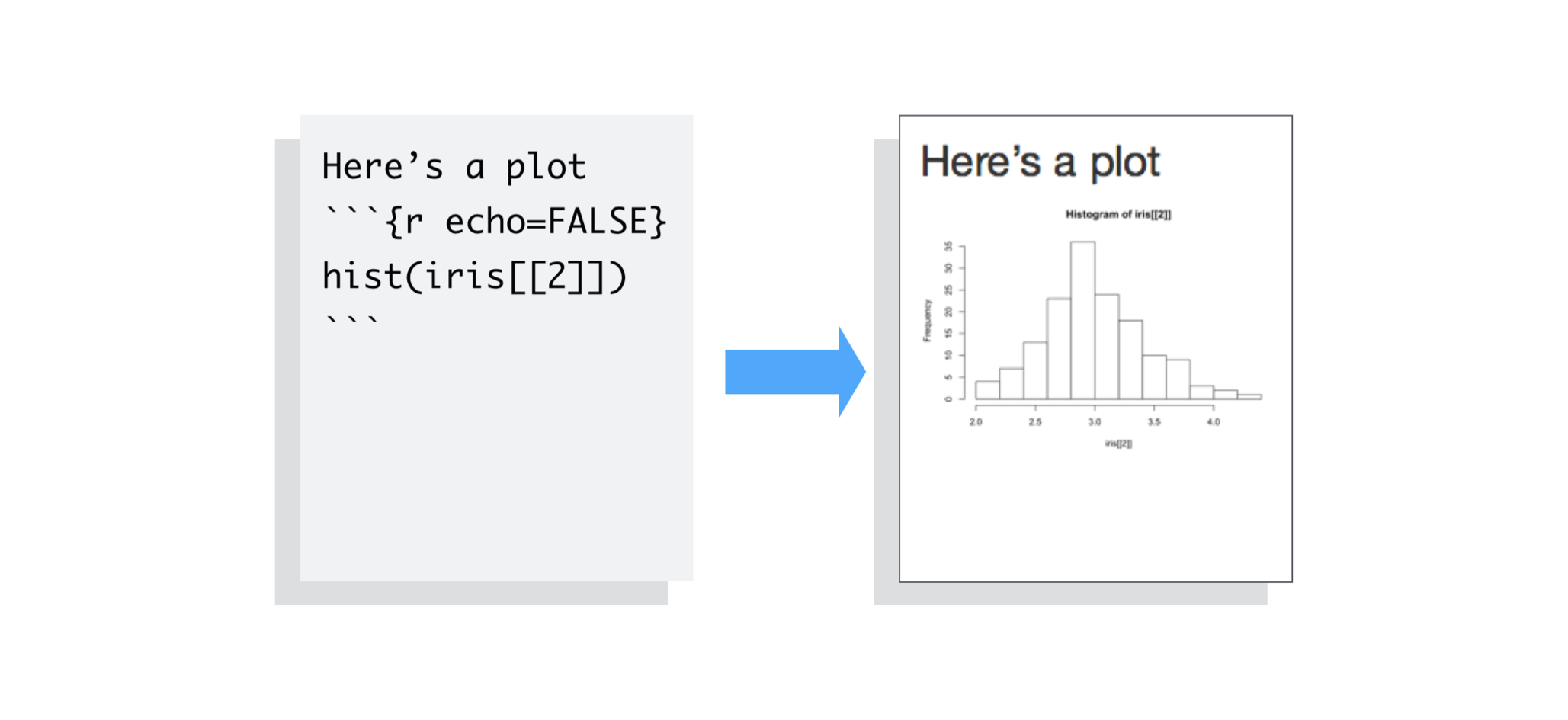
echo = Fake is very handy for adding plots to a report, since y'all usually exercise not want to see the code that generates the plot.
echo and eval are not the only arguments that you can utilize to customize code chunks. You tin learn more about formatting the output of lawmaking chunks at the rmarkdown and knitr websites.
Inline code
To embed R code in a line of text, environment the code with a pair of backticks and the letter r, like this.
Two plus 2 equals 4. knitr will supercede the inline code with its result in your terminal document (inline lawmaking is always replaced by its effect). The result will appear every bit if information technology were part of the original text. For example, the snippet above will appear similar this:

YAML for render parameters
Y'all tin use a YAML header to command how rmarkdown renders your .Rmd file. A YAML header is a section of key: value pairs surrounded by --- marks, similar beneath
--- title: "Untitled" author: "Garrett" appointment: "July 10, 2014" output: html_document --- Some inline R code, 4. The output: value determines what blazon of output to convert the file into when you call rmarkdown::render(). Note: you practice not need to specify output: if yous return your file with the RStudio IDE knit push button.
output: recognizes the post-obit values:
-
html_document, which will create HTML output (default) -
pdf_document, which will create PDF output -
word_document, which will create Word output
If yous utilise the RStudio IDE knit button to render your file, the selection you make in the gui volition override the output: setting.
Slideshows
You tin can besides use the output: value to return your document as a slideshow.
-
output: ioslides_presentationwill create an ioslides (HTML5) slideshow -
output: beamer_presentationwill create a beamer (PDF) slideshow
Annotation: The knit button in the RStudio IDE will update to prove slideshow options when you include 1 of the to a higher place output values and save your .Rmd file.
rmarkdown will convert your document into a slideshow by starting a new slide at each header or horizontal dominion (e.yard., ***).
Visit rmakdown.rstudio.com to learn about more than YAML options that command the render process.
Recap
R Markdown documents provide quick, reproducible reporting from R. Yous write your document in markdown and embed executable R lawmaking chunks with the knitr syntax.
Y'all tin can update your certificate at whatever time by re-knitting the code chunks.
You can and so convert your document into several common formats.
R Markdown documents implement Donald's Knuth's idea of literate programming and take the manual labor out of writing and maintaining reports. Moreover, they are quick to acquire. You already know ecnough about markdown, knitr, and YAML to begin writing your own R Markdown reports.
In the next article, Introduction to interactive documents, yous will learn how to add interactive Shiny components to an R Markdown report. This creates a quick workflow for writing light-weight Shiny apps.
To learn more about R Markdown and interactive documents, delight visit rmarkdown.rstudio.com.
palaciosbriat1956.blogspot.com
Source: https://rmarkdown.rstudio.com/articles_intro.html
0 Response to "How to Upload a File Into R and Then Knit It"
Post a Comment